
Your needs, this model
Does it fit your priorities?
Does the LTSTND let me change its height after setup?
Yes, StarTech describes three leg settings that place the back of the platform 7.3, 8.3 or 9.3 inches above the desk. Its incline remains a fixed 22 degrees; those height settings do not alter the incline. Check whether the resulting screen position and keyboard angle fit the particular laptop and desk.
Explore this need in the finder →Is the LTSTND a good stand to pack for travel?
The manufacturer describes a multi-piece stand with a top plate, upper and lower legs, adjustment knobs, nuts and a wrench, but does not document a fold-flat travel arrangement. It weighs 3.2 kg before considering packaging. Treat it as a desktop fixture unless a specific seller confirms a different package or transport method.
Explore this need in the finder →How much laptop weight does the LTSTND support?
The capacity is not treated as settled here. The StarTech U.S. product page and the captured data-sheet features/specification table state 44 lb (20 kg), while the official PDF’s indexed narrative has a 22 lb (10 kg) statement. Since the official source text is inconsistent, do not use one number as a dependable laptop limit without checking the exact current technical sheet and asking the manufacturer. The separate 17-inch statement also does not prove fit.
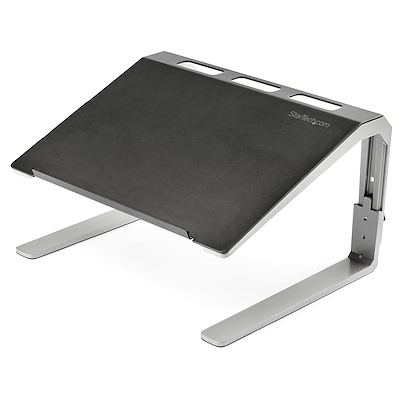
Explore this need in the finder →The StarTech.com LTSTND is a heavy desk platform that trades portability for a large support surface and three selectable rear heights. The top remains at one downward incline; the legs lift its back edge to 7.3, 8.3 or 9.3 inches. This is a different sort of adjustment from a continuously hinged riser or a stand that changes laptop angle. It is a substantial desktop accessory, not a compact travel stand.
Three height choices, one fixed incline
StarTech describes a 22-degree downward typing incline and three leg settings. The platform height is adjusted with the supplied knobs, so the change is discrete rather than a free-moving slider. The manufacturer does not give a separate screen-rise chart for a particular laptop; the selected back height is not the same as the display's final position. A thicker base, a deep chassis or a different screen hinge will change where the top of the computer sits.
The front lip is 12.7 mm high and the platform is described as 14.1 × 9.8 inches. That broad area may suit a larger notebook better than narrow support arms, but StarTech's “including 17-inch” language is not a fit table. Measure the laptop's base and inspect where its feet meet the steel plate. The stand's desk footprint, not just the laptop surface, should be compared with keyboard, mouse and monitor clearance.
What the capacity conflict means
The LTSTND's load statement is inconsistent across official StarTech materials. Its U.S. product page and the captured data-sheet feature and specification table list 44 pounds (20 kg). An official PDF narrative surfaced in a manufacturer web rendering gives 22 pounds (10 kg). The locally saved PDF's text extraction shows the higher figure in its narrative as well as the feature/table areas, so the disagreement appears to be across official renderings of the product sheet, not just between two unrelated sellers. There is no independent measurement here to resolve it.
For that reason, this assessment does not treat either number as a settled maximum. If load capacity is critical—particularly with an unusually heavy laptop—ask StarTech to confirm the current specification for the exact LTSTND revision rather than choosing the more favorable figure. A 17-inch display claim does not resolve the load discrepancy and does not show how a specific base fits the platform.
Material and assembly are part of the tradeoff
The upper plate is 2.5 mm steel and the legs are aluminum. StarTech lists the assembled product at 3.2 kg, significantly heavier than the other stands reviewed here. The package includes a top plate, four leg sections, nuts, two height knobs, a wrench and a quick-start guide. Setup is part of ownership; the documentation does not describe a fold-flat travel position or a carry sleeve. Taking the components apart for storage is not the same as a maker-supported folding mode.
Rubber feet protect the desk, the raised front edge helps retain the notebook, and channels at the rear manage cables. These details may be useful on a fixed desk where a dock, external keyboard or drive stays nearby. They do not establish that the LTSTND will remain motionless on every surface or that cable routing will suit a particular port layout. The manufacturer's non-slip and stability language should not be read as a performance test.
Who should choose a stationary platform?
The LTSTND is worth comparing if the stand will remain at a desk, a wide platform is more useful than a narrow bar, and three discrete heights are enough. It is a poor match for a bag-first routine or for someone who needs continuously variable height, multiple tilt angles or a rotating base. Before buying, confirm the exact LTSTND code, the current load limit, platform and desk clearance, the 22-degree fixed incline and the assembly parts. The lack of a precise fit chart and the unresolved capacity statement are material limitations, not details to smooth over.
Evidence, not a comfort promise
StarTech markets the stand as an ergonomic riser and says it can encourage more comfortable viewing. A fixed incline and taller rear edge can change the working arrangement, but they cannot determine an appropriate posture for every desk, person or laptop. This review does not claim hands-on use, typing tests, stability testing or measured thermal benefits. The assessment rests on the product's documented height options, fixed geometry, materials and stated desk-use design.
Key specifications
Key details at a glance
| Height-adjustable | Yes |
|---|---|
| Folds for storage | No |
| Swivel base | No |
| Supported placement | desk |
Use the exact model’s instructions for operating limits, supplied equipment and version differences.
Sources for this review
Sources for this assessment
Compare the setup, not just the silhouette
Use the finder to compare reviewed stands against the way you work and the features you actually need.