
Your needs, this model
Does it fit your priorities?
Does the StarTech riser bar adjust screen height?
The data sheet lists nine tilt settings but marks “Height Adjustment” as No. The hinge angle may shift where a screen edge sits, but StarTech does not publish a separate vertical lift setting or range. If height adjustment is essential, compare ADJ-LAPTOP-RISER or another stand with a documented lift mechanism instead.
Explore this need in the finder →What will I carry with the LAPTOP-RISER-BAR?
StarTech describes a folding aluminum frame that closes to 9.4 × 2 × 0.9 inches and includes a storage pouch. It lists the product mass as 329 g in the description and 341 g in the specifications table, so the exact mass is inconsistent in the source. The maker’s 15.6-inch screen claim still needs a base-width, base-depth and contact-pad check.
Explore this need in the finder →Which tilt settings are available?
The nine manufacturer-listed angles are 15, 27, 37, 45, 52, 60, 67, 75 and 84 degrees. The support width also adjusts up to 7.17 inches. These values describe stand settings, not laptop compatibility for every screen diagonal; check the notebook’s base width, feet and case against the support arms.
Explore this need in the finder →The StarTech.com LAPTOP-RISER-BAR is a pair of collapsible support arms, not a full-width height-adjustable platform. It offers nine laptop tilt angles and an adjustable support width, then folds down to a narrow bar with a pouch for carrying. Its appeal is the small packed form and the number of incline choices; the boundary is equally important: StarTech's technical table marks height adjustment “No.” A change in angle can move the screen edge, but the product does not provide a separate lift range.
Nine angles from low tilt to steep incline
The manufacturer lists positions of 15, 27, 37, 45, 52, 60, 67, 75 and 84 degrees. That selection gives a shopper more options than a two- or three-position stand, especially when the laptop keyboard itself is part of the arrangement. The frame also opens to a maximum width of 7.17 inches and can be narrowed for smaller supported devices. Before relying on it, compare the width of the laptop's base and the spacing of its feet with the two contact arms; the angle list does not guarantee that a particular chassis remains supported.
StarTech describes support for laptops up to a 15.6-inch screen diagonal and devices up to 10 kg. Those are broad maker limits rather than a tested list of model numbers. Screen diagonal does not tell you the width or depth of the base, and the 10 kg rating does not prove that the feet will sit on the support rails without case or vent interference. Check the actual laptop footprint and any protective shell.
Travel details and an internal weight discrepancy
This riser is the most bar-like form in the group. StarTech says it folds to 9.4 × 2 × 0.9 inches and includes a storage pouch. The product page describes portability and a fully collapsed stand, making the travel use evidence stronger than a stand that merely disassembles. Its surface pads and raised front lip are meant to prevent movement and cosmetic wear, but do not replace checking the exact fit.
The official data sheet gives two different item weights: the narrative says 329 grams, while the specification table says 341 grams. This review leaves the exact mass unresolved rather than choosing one figure. The difference is modest for many users but matters when comparing a packed kit by grams or ounces. The data sheet's dimensions and pouch inclusion are more useful for a first bag check, though no standalone pouch dimensions are supplied.
Aluminum open frame, without a cooling test
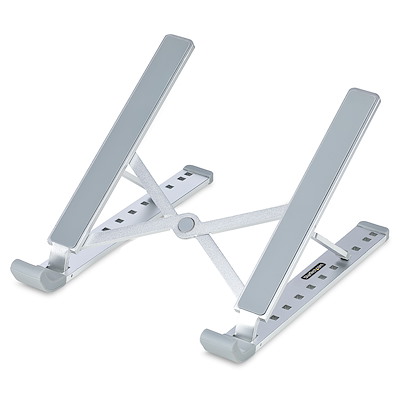
The silver anodized frame is aluminum, with rubber contact pads and a vented open area. StarTech describes the open construction as supporting passive airflow under the laptop. That is a design feature, not measured evidence that a certain computer will run cooler or quieter. The image shows the exact stand without a laptop; it cannot establish fit, stability under typing or device temperatures.
The product ships assembled, and no tool is needed to select an angle according to StarTech's description. The absence of a height setting keeps the mechanism simple, but the nine inclines should not be mistaken for nine vertical positions. If a stand has to raise the display by a particular amount, this is the wrong feature to filter on; compare a product that publishes height adjustment rather than inferring it from the moving support arm.
What to verify before selecting it
Check the LAPTOP-RISER-BAR maker code, the laptop's base dimensions and feet, the needed angle, the pouch and the bag's internal dimensions. The 15.6-inch and 10 kg statements are compatibility and load claims, not independent tests. This assessment is based on StarTech documentation, not physical use. It is a sensible model to compare when folding size and angle choice come first, but not when a defined screen-rise range or a rigid broad shelf is essential.
Key specifications
Key details at a glance
| Main material | Aluminum |
|---|---|
| Height-adjustable | No |
| Folds for storage | Yes |
| Swivel base | No |
| Supported placement | desk |
Use the exact model’s instructions for operating limits, supplied equipment and version differences.
Sources for this review
Sources for this assessment
Compare the setup, not just the silhouette
Use the finder to compare reviewed stands against the way you work and the features you actually need.