
Your needs, this model
Does it fit your priorities?
Will the R1 fit my exact MacBook or laptop?
Check the exact model and finish code. Satechi's older quick-start guide names MacBook 2015/2016 and Surface Pro 4, but its current R1 compatibility article lists many MacBook generations from 2020 onward as incompatible, with the relevant headings identifying ST-R1M. The 4-to-13-inch statement applies to phones and tablets, not a laptop fit chart. Ask Satechi about the exact computer and measure its complete base, feet and case; no supported laptop thickness or weight limit is published.
Explore this need in the finder →Does the R1 raise a laptop and fold for travel?
Yes, the maker describes a 270-degree mount hinge and a separate 180-degree base hinge, says the back hinge can elevate a MacBook, and instructs users to fold the stand flat for carry-on storage. The source does not give a vertical-rise range or folded dimensions. The 4.5 × 5.5 × 5.5-inch listing is not identified as the packed size, so check the folded form if bag clearance is critical.
Explore this need in the finder →Is the R1 a swiveling screen-sharing stand?
No separate swivel base is documented. Its 180-degree base hinge is part of the folding/articulation system; the R1 materials do not describe a turntable under the stand. Do not treat hinge movement as a documented swivel-base function.
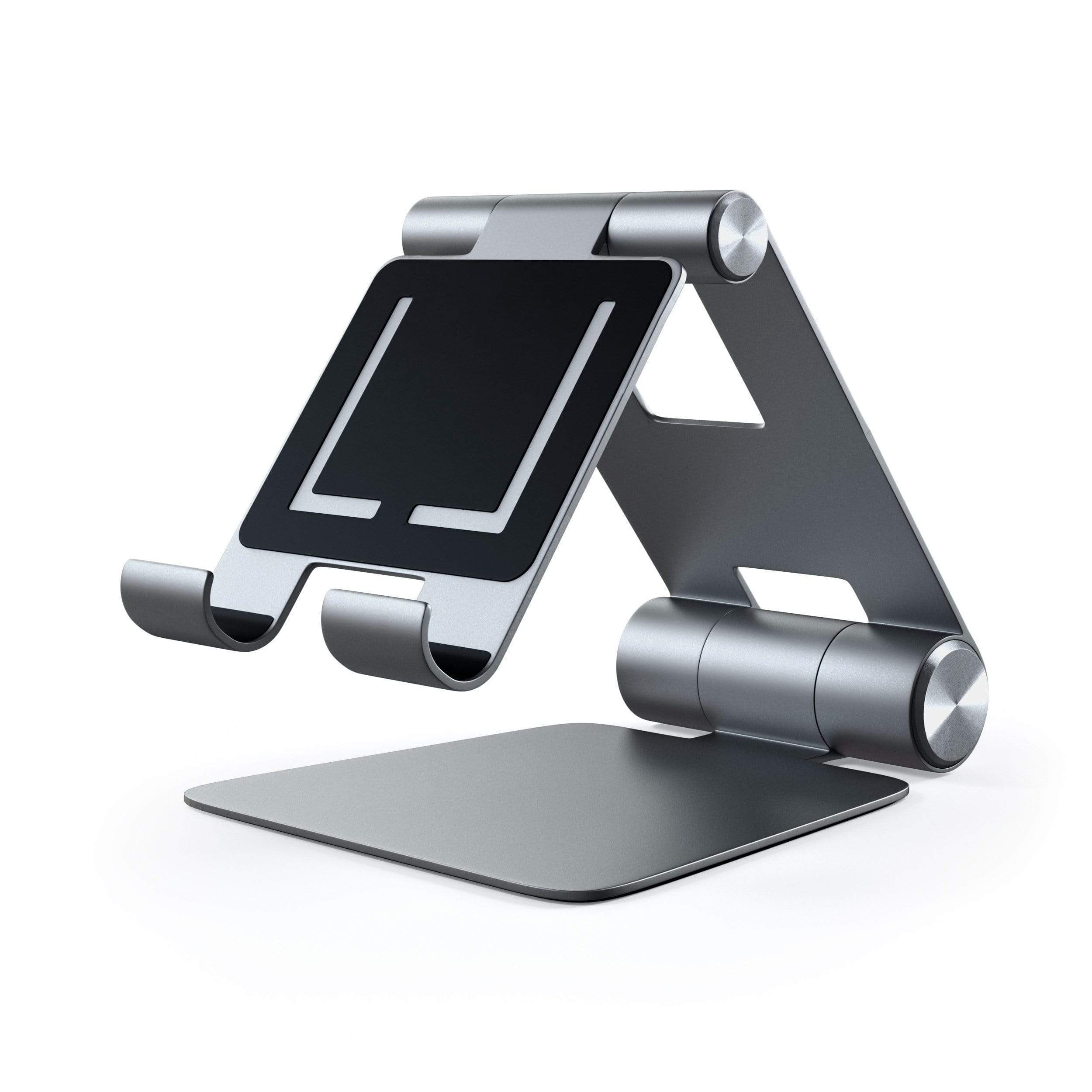
Explore this need in the finder →The Satechi R1 Aluminum Hinge Holder Foldable Stand is a small, articulated support for an open device, with two hinges that let the user change its viewing position and fold it flat. It is not the same kind of product as a fixed desktop riser or a turntable swivel stand. The useful question is whether the exact laptop or tablet is supported by the particular R1 edition: the maker's older guide names MacBook 2015/2016 and Surface Pro 4, while its current compatibility material warns against a number of newer MacBook generations. This document-based assessment does not claim a hands-on test, fit check or ownership.
Two hinges, but no documented swivel base
Satechi describes a 270-degree mount hinge and a separate 180-degree base hinge. The first changes the device-support angle; the second folds and articulates the base geometry. Those ranges help explain why the R1 can move between a flatter travel form and a raised viewing position, but the manufacturer does not publish an indexed height schedule or a vertical rise range. Nor does the phrase “base hinge” mean that the stand turns on a desk-mounted swivel disk. The reviewed product materials document hinges, not a turntable under the stand.
The R1 quick-start guide shows adjustment for viewing angle and elevation, and the user manual says the two hinges close the support flat. Non-slip padding is listed on the device contact surface, while the product page identifies aluminum construction. Those are design details, not independent evidence about how securely an unlisted computer fits, how much force the hinge will hold, or how much screen height a specific laptop will gain.
Compatibility is the decisive purchase check
The product page says the R1 accommodates most mobile phones and tablets with 4-to-13-inch displays. Its quick-start guide also names a short list of older devices: MacBook 2015/2016 and Microsoft Surface Pro 4 appear among the examples, alongside tablets, phones and handheld electronics. That wording does not establish a universal laptop size range; the 4-to-13-inch statement is explicitly about phones and tablets, not a laptop chassis chart.
There is a meaningful generation boundary for MacBook buyers. Satechi's current R1 device-compatibility page lists numerous newer MacBook Air and Pro models among incompatible devices, including many machines released from 2020 onward. The page's incompatibility headings refer to the ST-R1M variant, so verify the precise model code with Satechi if your laptop is close to this boundary rather than assuming finishes are mechanically identical. The original guide's reference to MacBook 2015/2016 should not be stretched to current MacBooks simply because the product name still appears on the U.S. store. For other laptops, the reviewed sources do not give a dimensional fit table, a supported thickness range or a laptop-specific weight limit.
Before ordering, identify the complete laptop model and measure its base, feet, case and thickness at the contact points. Ask the maker whether that exact machine fits the exact finish code. A product photograph of a laptop on the stand cannot answer the fit question for a different device, and a broad display-size label is not a substitute for the underside dimensions.
Adjustable position without a stated lift span
For an exact supported device, the two hinges give more placement options than a fixed one-piece slope. The back hinge can raise the device, while the mount hinge changes the screen angle. But Satechi publishes degrees of hinge travel rather than a numerical range from the desk to the display. A buyer who needs a minimum eye-line height should not treat “270 degrees” as a lift measurement. Check the screen's final position and the keyboard arrangement for the actual setup; a separate keyboard may be preferable when the laptop sits higher, but the reviewed sources do not make an ergonomic outcome claim.
The product page lists the stand at 4.5 inches long, 5.5 inches wide, 5.5 inches high and 11.88 ounces (340 grams). These are the manufacturer's general dimensions; the page does not identify them as the folded envelope. The guide says the stand folds flat and can be stored in carry-on luggage, which supports a travel use case, but no folded length, width or thickness is supplied. If backpack or luggage space is a hard limit, confirm the folded dimensions and protect the hinge surfaces rather than relying on a thin-looking image.
Where it belongs among other laptop stands
The R1 is best compared with compact folding supports for a single open device. It offers a different mechanism from a broad-platform riser: the hinge arrangement can change the angle and elevation, while a fixed stand uses one working position. The separate Satechi Dual Vertical Laptop Stand serves a different desk job altogether, holding a closed laptop and a second device upright in two slots. A conventional laptop stand that claims a multi-inch lift, a documented chassis range or a rotating base should be evaluated on those specific claims rather than by appearance.
On November 1, 2026, the R1 remained visible in Satechi's U.S.-facing Stands & Mounts collection and product page, both of which displayed Sold Out. That is a dated observation of the manufacturer's pages, not a claim that the model has been permanently discontinued or that no other retailer has it. The page lists a two-year warranty and a 30-day return policy; check the exact seller's terms and current availability independently.
Who should investigate it—and what is still unknown
The R1 merits a closer look if a compact, fold-flat, two-hinge support suits the travel routine and the exact device is confirmed compatible. It is a poor choice to assume-fit for a current MacBook, to use as a promised swivel base, or to buy when a numeric screen-rise target is essential. Before purchase, verify the exact finish/SKU, model compatibility, folded dimensions, load guidance and return route. The official page gives useful dimensions and a general device range, but no laptop fit chart or maximum laptop load.
This assessment draws on Satechi's U.S. product listing, the R1 quick-start guide, the user manual, the current compatibility article and dimension/home-office support entries. It does not report human testing, hinge-force measurements, device fit, stability testing or observed use. Confirm the exact configuration and current terms with the manufacturer or retailer before making a buying decision.
Key specifications
Key details at a glance
| Main material | aluminum |
|---|---|
| Height-adjustable | Yes |
| Folds for storage | Yes |
| Swivel base | No |
| Supported placement | desk |
Use the exact model’s instructions for operating limits, supplied equipment and version differences.
Sources for this review
Sources for this assessment
Compare the setup, not just the silhouette
Use the finder to compare reviewed stands against the way you work and the features you actually need.