
Your needs, this model
Does it fit your priorities?
Can the Dual Vertical hold my laptop with its case?
Check Satechi's device-compatibility list for the exact ST-ADVSM-compatible computer and measure the complete closed thickness against the slot you plan to use. The guide says a case is not recommended for the 14-inch M1 Pro and 16-inch M1 Max MacBook Pro because they fit snugly; a thinner MacBook Air may take a slim case. For iPads, the published case limit is 3–4 mm. No general laptop thickness range or weight limit is published.
Explore this need in the finder →Does this stand raise an open laptop or fold for travel?
No. Satechi describes a fixed vertical stand with two device slots for a desk. It is intended to hold devices upright, not to elevate an open laptop screen, adjust its working height, fold flat or swivel on its base.
Explore this need in the finder →Will it support a closed laptop connected to an external display?
The product page and images describe or depict an external-monitor workstation with a vertical laptop, but the compatibility guide does not certify closed-lid behavior for your exact computer, display, power and port arrangement. Confirm the laptop maker's clamshell instructions and measure cable clearance before relying on that scenario.
Explore this need in the finder →The Satechi Dual Vertical Laptop Stand (ST-ADVSM) is a desk organizer for two upright devices, not an open-laptop riser. It is designed around two slots of different widths, so one closed laptop can be stored vertically alongside a tablet or phone while the desk is arranged around a separate display and input devices. The model-specific fit list and slot widths matter more than the “dual” label: this document-based assessment does not claim a hands-on fit test, a load test or ownership.
A closed-device holder, not a typing platform
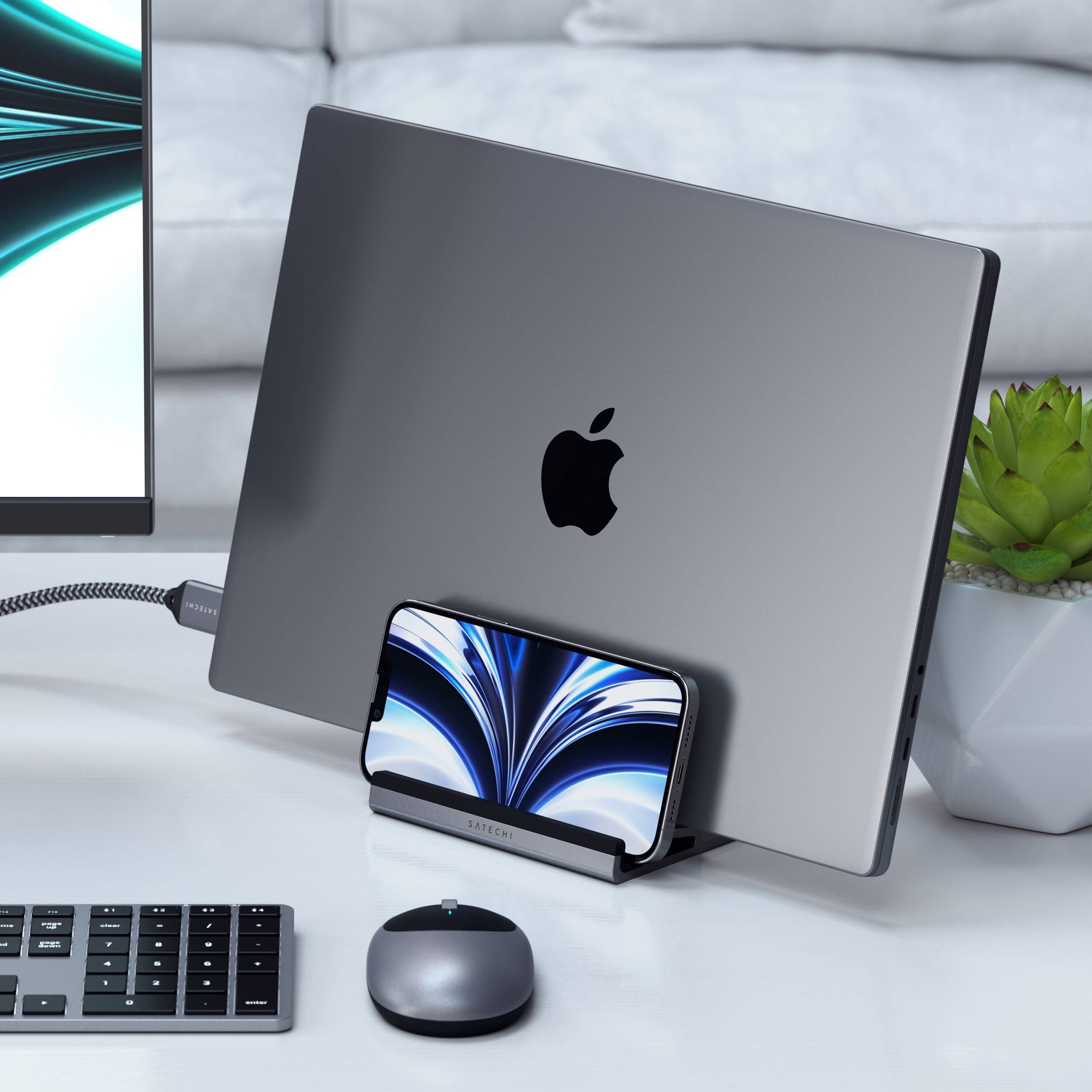
Satechi says the stand holds two devices vertically and supports a laptop and tablet at the same time. Its product material shows a closed MacBook and a phone on a desk near an external monitor; the setup guide likewise describes two upright devices. That makes the stand a distinct choice for storing a closed laptop between uses, reclaiming part of a desktop and keeping a second device upright. It does not raise an open screen into a more comfortable typing position, and it is not a substitute for a conventional laptop riser if the laptop's own keyboard and display need to stay in use.
The manufacturer's quick-start guide gives the key dimensions of the two openings: the front slot is about 12 mm wide, while the rear slot is about 20 mm. The guide also lists overall dimensions as 5 × 3.5 inches with 6 inches of total length across. It does not attach an axis diagram to the 5-by-3.5-inch figures, so treat them as a general footprint description rather than a guaranteed front-to-back clearance measurement. The base, power cables and external monitor still need room on the actual desk.
Case thickness and model identity determine the fit
The narrower and wider slot can accommodate different device profiles, but the manufacturer's fit guidance is not the same as an unrestricted width range. Satechi's setup guide says a case is not recommended for the 14-inch MacBook Pro with M1 Pro or 16-inch MacBook Pro with M1 Max because those laptops fit snugly without one. It says thinner laptops such as MacBook Air may accept a slim case, and iPad cases may be up to 3–4 mm thick. Measure the laptop's complete closed thickness at the contact point, including any shell, and verify which slot is intended for that device before treating a case fit as established.
Satechi's device-compatibility article lists specific compatible and incompatible models and states that devices not named there have not been confirmed by the company. The current product page also gives examples across MacBook, iPad, Dell XPS, Surface Pro, Pixelbook and Spectre lines. These are model-specific guidance, not a universal laptop-size promise. If the exact computer is missing from the current compatibility article, ask Satechi for a confirmation instead of extrapolating from a similar screen diagonal.
The product page identifies a single Space Gray configuration, SKU ST-ADVSM, UPC 879961007058. It lists no laptop load limit or product weight. The two openings and non-slip contact pads are useful design details; they do not prove that every laptop, case or tablet will sit securely, especially if the device is thicker than the listed examples.
Desk organization comes with a closed-lid caveat
The product images show the laptop stored upright next to an external monitor, and the page describes connecting to an external monitor. That visual is helpful for understanding the intended desk layout, but a photograph does not establish the operating-system settings, closed-lid power behavior or port/cable fit for a particular computer. Check the laptop manufacturer's instructions and your exact display-and-power arrangement if the notebook will be closed while acting as a computer. Keep the cables clear of the slot and make sure the desk has enough open space to lift each device out without dragging a connector.
The Dual Vertical is not documented as height-adjustable, foldable for travel or equipped with a swivel base. It organizes closed devices in a fixed desktop footprint. That separates it from Satechi's folding R1 hinge holder, which supports one open device, and from a fixed vertical clamp such as a model that publishes interchangeable insert widths. Do not choose it for a required travel fold, adjustable screen position, lap use or screen-sharing rotation.
What to verify before buying
First check whether the exact laptop appears on Satechi's compatibility list. Then measure the complete chassis and case thickness and compare it with both 12 mm and 20 mm slots; if the fit is close, get a manufacturer answer rather than assuming compressible pads solve it. For a tablet in a case, the published 3–4 mm boundary is the useful starting point. Also compare the 5 × 3.5-inch, 6-inch-across manufacturer footprint wording with the desk space available for the stand, device removal and cable bends. The sources reviewed here do not disclose a maximum device weight, so ask before using it with an unusually heavy device.
On November 1, 2026, the product remained on Satechi's U.S.-facing Stands & Mounts collection and its product page displayed Sold Out. That is a dated manufacturer-page observation, not a permanent discontinuation finding, an offer from another retailer or a price recommendation. Confirm the exact Space Gray SKU, package, availability, warranty and return terms with the seller before ordering.
Who should investigate it—and what is still unknown
This model is worth investigating for a stationary desk that needs to store a compatible closed laptop and another device upright. It is a poor fit for a user looking for an elevated open notebook, a portable folding support, a height-adjustable platform or a general-purpose clamp with verified fit for an unlisted laptop. It may free up desk space, but no measured space-saving result, thermal improvement or stability test is supplied by the sources.
This assessment uses the exact Satechi U.S. product page and the manufacturer's Quick Start Guide and device-compatibility article. It does not claim hands-on use, laptop fit, drop resistance, load testing, improved cooling, display compatibility for a particular closed-lid setup or user experience. Verify the exact machine, case, slot and seller terms before deciding.
Key specifications
Key details at a glance
| Main material | high-grade stress-resistant aluminum with non-slip pads |
|---|---|
| Height-adjustable | No |
| Folds for storage | No |
| Swivel base | No |
| Supported placement | desk |
Use the exact model’s instructions for operating limits, supplied equipment and version differences.
Sources for this review
Sources for this assessment
Compare the setup, not just the silhouette
Use the finder to compare reviewed stands against the way you work and the features you actually need.