
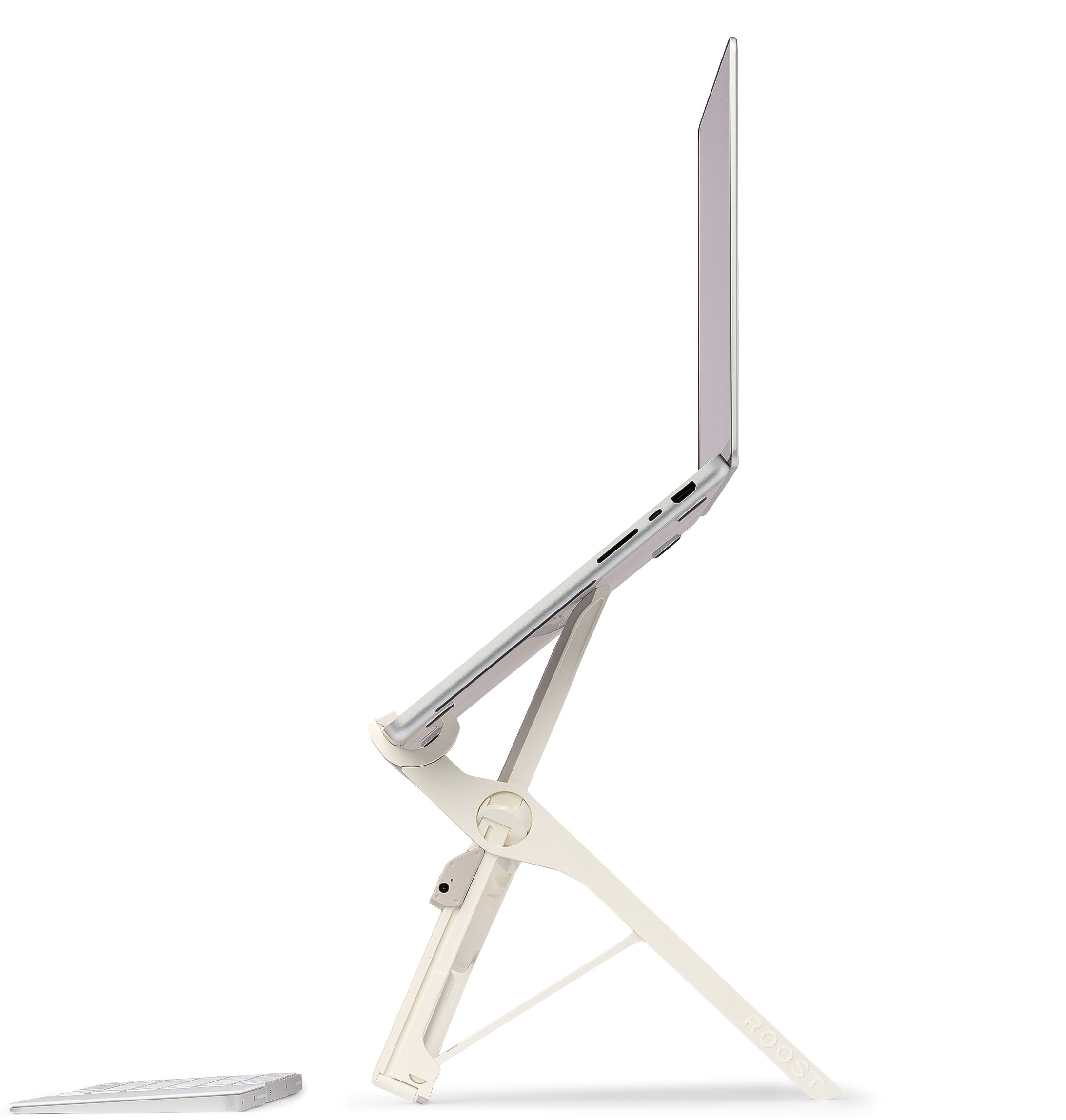
Your needs, this model
Does it fit your priorities?
What changes between Roost V3 and V3 Plus?
Roost lists 11 V3 Plus positions and 5–14 inches of screen lift, compared with seven V3 positions and 6.5–12.5 inches. V3 Plus adds a quick-release adjustment that the V3 page does not list. Both are shown with the same 1 × 1.5 × 13-inch folded size. Dune and Onyx are separate V3 Plus listings, but the current pages describe the same mechanism and feature set; their documented difference is finish/listing identity.
Explore this need in the finder →Can I adjust the V3 Plus without removing my laptop?
The manufacturer describes the V3 Plus quick-release mechanism as changing height without removing the laptop and says a height can be preset with one hand while the stand is folded. Its current general how-to page instructs users to lower the height only with the laptop on the stand. Follow the exact setup sequence rather than treating the ratchet as a substitute for instructions.
Explore this need in the finder →Is the V3 Plus a practical folding travel choice?
Roost describes the V3 Plus as pack-flat and lists folded dimensions of 1 × 1.5 × 13 inches. The same listing gives 5–14 inches of screen lift across 11 positions, so it can combine folding for packing with selectable desk height. The maker's stated 6 oz / 178 g pair and its unitless raw option weights do not establish exact carry mass; leave room for the folded stand and verify the laptop edge is less than 0.75 inch thick.
Explore this need in the finder →The Roost V3 Plus is a folding open-laptop stand for people who want more than one working screen height and need to pack the support between sessions. Its current manufacturer page lists 11 positions, a 5–14-inch screen-lift range, and a quick-release mechanism that can change height without removing the computer. That combination distinguishes it from both the fixed-height portable frames in this library and the standard Roost V3.
The Plus changes how adjustment works
Roost's V3/V3 Plus comparison lists 11 settings and a 5–14-inch screen lift for the Plus. The regular V3 has seven settings with a 6.5–12.5-inch range. Those are meaningful boundaries: the Plus starts lower and reaches higher, and its adjustment can be made without lifting the laptop off the stand. The product page also says a height can be preset with one hand while the stand is folded. The range describes screen lift, not a guaranteed final display height. Your laptop's thickness, screen hinge, and position on the supports affect the result.
The current Roost use page includes an important operating note: lower the height only with the laptop on the stand. Treat that as part of the adjustment procedure, not an invitation to force the ratchet. The V3 Plus's quick release is a listed mechanism; it does not make the stand a powered or infinitely variable desk riser, and the source gives no model-by-model chart of each intermediate stop.
Dune and Onyx are separate listings of the same functional model
Roost currently presents a V3 Plus Dune page and a V3 Plus Onyx page. Their feature descriptions, screen-lift range, setting count, quick-release function, and folded-size statement match. The option data preserves separate listing identities and raw SKUs—“white” for Dune and “roost_v3Plus_black” for Onyx—but does not document a mechanism difference. This assessment treats the color/listing options as variants of one V3 Plus model, not as separate performance recommendations. Verify the exact finish and offer title because the manufacturer keeps the two pages distinct.
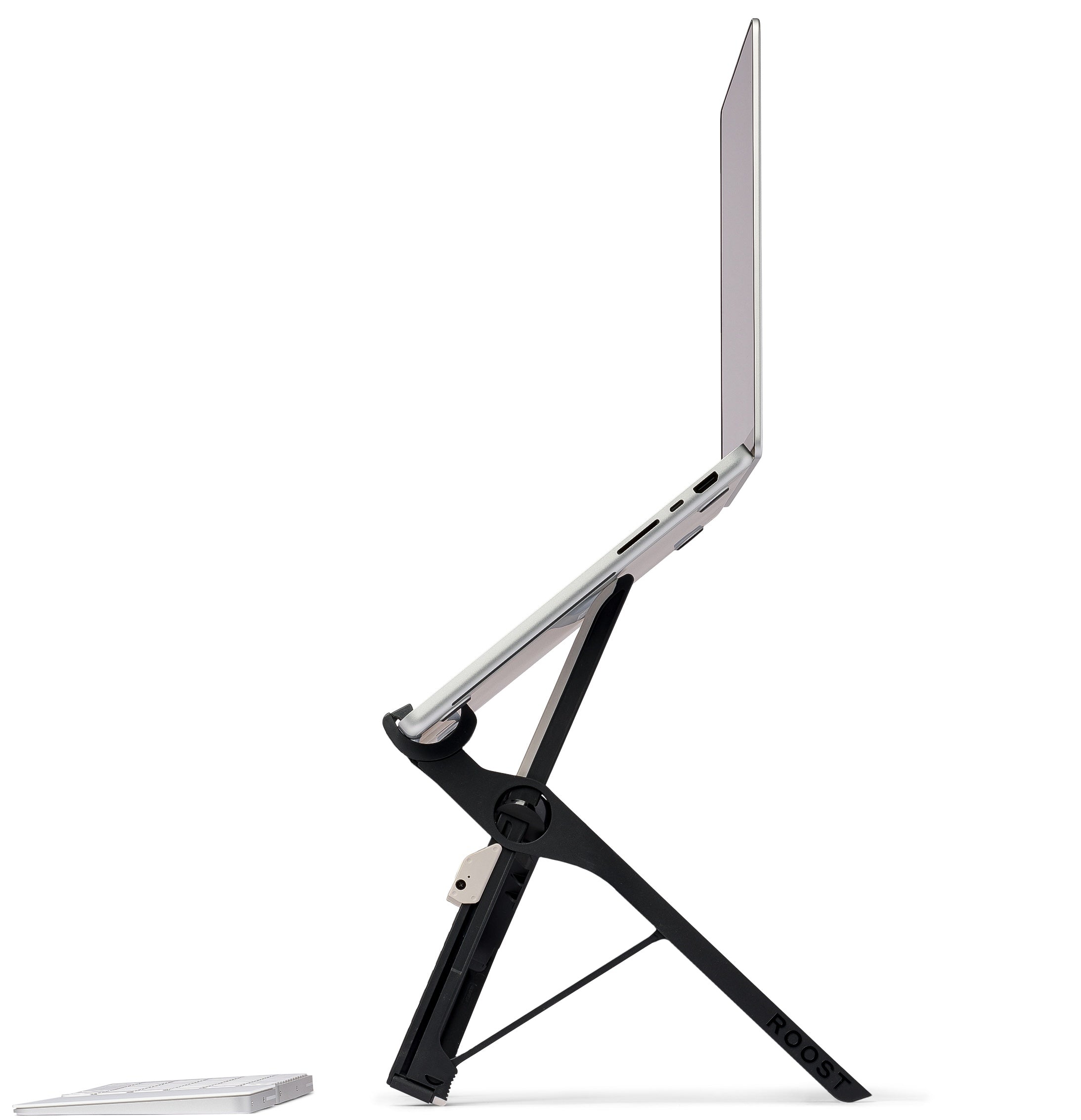
Measure the laptop, not just its screen diagonal
The Plus page says it fits 12–18-inch laptops and uses broad all-makes wording. Roost's separate fitting guide gives a stricter condition for the front chassis edge: it must be less than 0.75 inch (1.9 cm) thick. “Less than” matters; a front edge exactly at the stated boundary is not within that wording. Measure where the grips will touch, including a protective case if you leave it on, and consider the laptop's feet and bevels. The page does not provide a full footprint drawing or a complete model list, so a screen-size label is not enough to establish fit.
The folded dimensions are listed as 1 × 1.5 × 13 inches, the same as the V3. These are useful for comparing the stored shape with a bag slot, but the product page does not label each dimension axis or publish the deployed footprint. Leave desk space for the support legs, the raised screen, cable bends, and separate input devices if you type for long periods. Once the built-in keyboard rises with the laptop, its position changes too.
Carry weight and material remain unresolved
The product pages pair 6 ounces with 178 grams. Those two units do not convert exactly, and the current option records expose raw weight values of 275 for Dune and 266 for Onyx without stating a unit. Neither raw number can be responsibly translated into a verified carry mass from the provided data. The listing uses lightweight language, but this assessment leaves a comparable weight blank. Ask for a current item weight if it is a purchase constraint. The V3 Plus product descriptions also do not establish a model-specific material breakdown; an unversioned older Roost flyer is not used to fill that gap.
The manufacturer describes the screen as “perfectly still” and refers to high-stiffness materials. Those are product claims, not independent stability or vibration measurements. A stand with several adjustments still needs a level, suitable surface and a correct laptop fit. This review does not claim to have tried the mechanism, measured flex, tested a device on it, or evaluated long-term wear.
When the V3 Plus is the stronger match
Compared with the V3, the Plus is the more flexible documented option if you need both folding travel and a wider height range, especially if making an adjustment without removing the laptop is important. Its simultaneous foldable and height-adjustable capabilities are supported by one operating arrangement: an open laptop at a desk, with the stand folding only when it is packed. Compared with a fixed travel riser, it offers more setup choices; compared with a full-size desk column, the folded form is much slimmer, though no deployed footprint is published.
The Plus is not documented as a lap support or a swiveling base, and it should not be chosen for either requirement. Its on-page ergonomic copy cannot decide whether a given screen position will suit your chair, eyesight, or desk. Compare the published range with your target, then check the Dune listing, Onyx listing, and manufacturer fit guide for the exact offer. The assessment relies on manufacturer information and exact official finish images, not hands-on testing or a claim of personal use.
Key specifications
Key details at a glance
| Manufacturer-listed height range | 5–14 inches of screen lift across 11 selectable positions; product page also identifies 12–18-inch laptops, but final screen position and physical fit depend on the laptop |
|---|---|
| Height-adjustable | Yes |
| Folds for storage | Yes |
| Swivel base | No |
| Supported placement | desk |
Use the exact model’s instructions for operating limits, supplied equipment and version differences.
Sources for this review
Sources for this assessment
Compare the setup, not just the silhouette
Use the finder to compare reviewed stands against the way you work and the features you actually need.